Answer Engine Optimization: The Reputation Signal Nobody Mentions
Most AEO advice is schema and content. But AI recommends brands based on sentiment too. Here is the reputation layer of AEO, and how DOPE protects it.

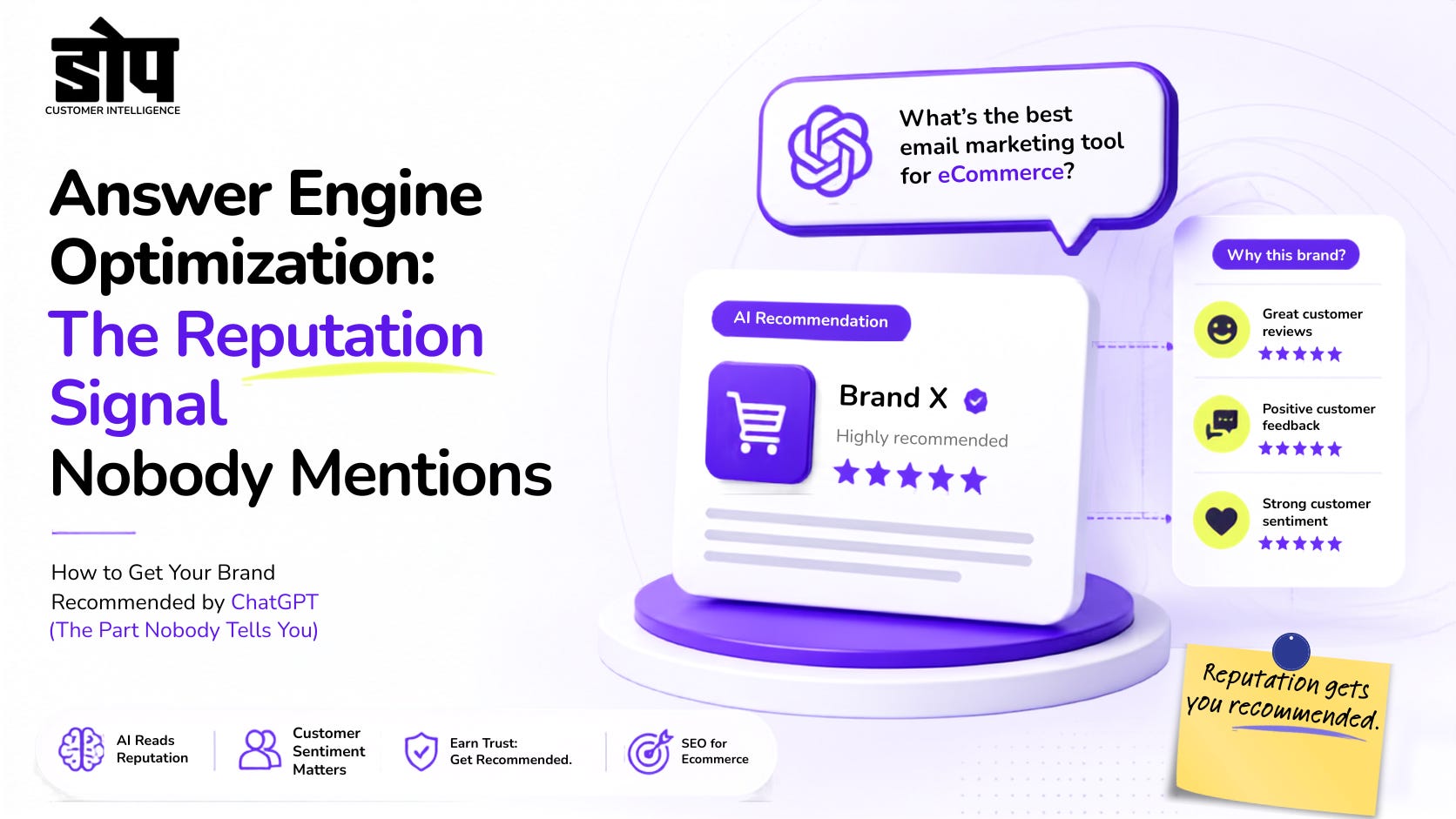
What is answer engine optimization and what actually gets you recommended?
Answer engine optimization (AEO) is the practice of structuring your brand and content so AI platforms like ChatGPT, Perplexity, and Google AI Overviews cite and recommend you when buyers ask questions. Most guides cover the technical half: schema, clear answers, entity clarity, third-party mentions. The half they skip is reputation. When an AI recommends a product, it weighs aggregate customer sentiment and reviews, so your reputation signal decides whether you make the list, which is the layer DOPE protects.
This is not optional anymore. Over 60% of searches now end without a click, and a query like “best CRM for B2B SaaS” in ChatGPT returns a ranked list of five products with citations, not ten blue links (2026 research). Semrush projects AI search visitors will surpass traditional organic traffic by early 2028. If AI is not recommending your brand, you are invisible at the exact moment a customer is choosing. Here is how to fix it, including the part most guides leave out.
The technical half of AEO (do this, it’s table stakes)
Start with what every AEO guide correctly tells you, because it is necessary.
Answer engines extract, trust, and cite content that is structured for them. That means leading each page with a clear, direct answer, then backing it with evidence. It means question-based headings, schema markup that reflects your visible content, and comprehensive topic coverage rather than one thin page. It means entity clarity, making sure AI can connect your brand to the right concepts and category.
And it means staying current: pages not refreshed quarterly are roughly 3x more likely to lose their AI citations, because 40 to 60% of AI citations change every month (AirOps, Profound). AEO is not set-and-forget. This is real work and it matters. It is also the half everyone is already talking about.
The half nobody mentions: AI reads your reputation
Here is what the schema-and-content crowd leaves out. When an AI answer engine recommends a product to a shopper, it does not only read your website. It reads what other people say about you.
A shopper does not ask ChatGPT “what does Brand X’s website claim.” They ask “what is the best gentle cleanser for sensitive skin.” To answer, the AI synthesizes across reviews, marketplace ratings, forums, and third-party mentions, then names the brands the evidence supports. Your product reviews, your google rating, the sentiment in what customers wrote, become direct inputs into whether you get named or skipped.
This is why a brand can do everything technically right and still lose. Perfect schema does not help if the aggregate sentiment the AI reads says your product runs small, ships slow, or disappoints. As one AEO team put it, answer engines think in solutions, not superlatives, they are not moved by your marketing language, they are moved by the evidence. And a large share of that evidence is your customers’ own words.
Why reputation is the hardest AEO input to fake
You can rewrite your page in an afternoon. You cannot rewrite what thousands of customers have said about you.
That is exactly why sentiment is such a powerful signal for AI, and such a durable moat for the brands that earn it. Schema is copyable. A comprehensive FAQ is copyable. Genuine customer sentiment is not. It has to be earned across thousands of real experiences, which makes it the one AEO input a competitor cannot shortcut.
And it compounds with the oldest gap in customer feedback. Only about 1 in 26 unhappy customers ever says anything (ThinkJar), but the ones who do are now feeding the exact corpus AI reads to decide your recommendations. Every unresolved frustration that becomes a public review is not just one lost sale, it is a negative data point in the evidence pool AI consults for every future shopper who asks. Reputation is the AEO input with the longest tail.
How DOPE protects your AEO reputation signal
DOPE is a customer intelligence tool for Shopify and D2C brands, and it works on the AEO layer the tools cannot touch: the reputation signal itself.
While AEO software optimizes your schema and tracks your citations, DOPE works upstream on the evidence those citations are built from. It reads behavior and sentiment across your whole customer base and surfaces the customers turning unhappy before they post a negative review, and the promoters before their goodwill cools. Fewer bad data points enter the pool AI reads. More good ones do. Over time, that is what shifts the aggregate sentiment an answer engine weighs when it decides whether to name you.
Think of it as two halves of one job. AEO tools make you legible to AI. DOPE helps make you recommendable, by protecting the earned sentiment that AI actually trusts. You can have flawless structured data and still not get picked if the evidence says otherwise. DOPE works on the evidence.
A note on how DOPE works: it surfaces which customers to reach and why, then you act on your own channels, in your own voice, and fix the underlying issues. It does not contact customers for you and it is not an AEO or schema tool. It is the intelligence layer that protects the reputation those tools depend on. For the agent-mediated version of this, see your next lost sale won’t have a bounce rate, and for how AI crystallizes review themes, your star rating was protecting you.
FAQ
What is answer engine optimization (AEO)?
AEO is the practice of structuring your brand, content, and data so AI platforms like ChatGPT, Perplexity, and Google AI Overviews cite and recommend you when users ask questions. Unlike traditional SEO, which optimizes for ranking a page, AEO optimizes for being named directly inside the AI’s answer.
How do I get my brand recommended by ChatGPT?
Two layers. Technically: lead pages with clear answers, use schema and question-based headings, ensure entity clarity, and refresh content quarterly. Reputationally: earn strong, genuine customer sentiment, since AI weighs aggregate reviews and feedback when deciding which brands to recommend. Most guides cover only the first layer.
Does AI use customer reviews to recommend products?
Yes. When an AI recommends a product, it synthesizes across reviews, ratings, forums, and third-party mentions, not just your website. Your product reviews and customer sentiment become direct inputs into whether you get named, which is why reputation is a core AEO signal.
Why isn’t my brand showing up in AI recommendations despite good SEO?
Traditional SEO metrics like backlinks and keywords correlate poorly with AI citations, and technical AEO alone is not enough. If aggregate customer sentiment about your product is weak, AI may skip you even with perfect schema, because answer engines weigh evidence over marketing language.
Does DOPE do answer engine optimization?
Not the technical part. DOPE is a customer intelligence tool that protects the reputation signal AEO depends on. It surfaces unhappy customers before they post and promoters worth activating, improving the aggregate sentiment AI reads. You still handle schema and content separately; DOPE works on the earned-trust layer.